Le Val decorated shelter
An attempt to understand
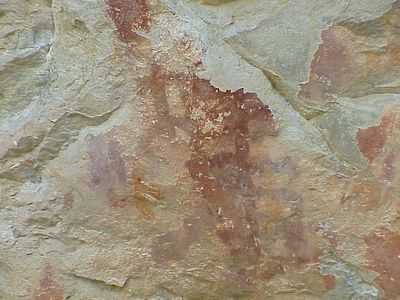
Stones, as a support of culture
Madre de los metales, te quemaron,
Te mordieron, te martirizaron,
Te corroyeron, te pudrieron,
Mas tarde, cuando los idolos
Ya no pudieron defenderte.
Pablo Neruda, Canto general
Support et symbolism of the "Gueillet" paintings
The impact of agriculture on
religious conception
Hunters
The discovery of agriculture and the
settlement of people
Discovery
of metal
Rock engravings or paintings
as a witness of a culture
The
"vallée des merveilles"
Caramy
valley
Relationship
between the object and the period
Tentative for a dating of
the paintings of the Gueillet shelter
Support et symbolism of the "Gueillet" paintings
The first bare rupestral paintings date the Paleolithic and extend starting 50 000 years ago in a big part of Central and western Europe, Ural in the Atlantic Ocean. They are always realized in uninhabitable caves and in with difficulty accessible places, as if their execution required certain secret or certain intimacy with the nature, the earth. To arrive in front of the walls of the cave of Niaux or that of " three brothers ", it is necessary to to go through hundreds of meters of galleries; to Lascaux, we reach the lower gallery - where is one of the masterpiece of the Paleolithic art - by going down by a rope ladder a six thirty metre deep well . On a more modest plan maybe, the paintings of the Age of metals of the Caramy valley - on the municipality of Tourves, 15 km from Le Val - were often executed far from the entrance, and in place to which access is difficult, uninhabitable caves themselves hidden in a narrow and wild valley the access of which is, and had to be, difficult and who cannot be of use to the agriculture. The sacred and initiatory character, even magico-religious of these paintings makes no more doubt, and in the case of the Paleolithic paintings comparison is made possible by the observation of the last hunters and primitive peoples of Africa or Australia, pygmies Bambouti or Bochimans for example which present similar magico-religious faiths.
So the shelter of Gueillet, opened to all the winds, visible of all the wide and fertile valley which extends at its feet, deviates fundamentally from all the sites which we quoted previously, by having losing this character of darkness which characterized them. If the Paleolithic paintings can be interpreted as being supports for initiatory rites before the hunting or during the beginning of a year, the initiation which for all the peoples asks for certain mystery and the execution of different ordeal - whose access to the decorated rooms could constitute one of them - before being able to practice the rite strictly speaking, we can push aside here this hypothesis; encouraged in it by the corpus of figures itself who contains no scene of hunting or initiatory character. The paintings of the high valley of Caramy, or those of the gorges of Ollioules, present, at the contrary, these characters, whether it is for rites in touch with the hunting as in the cave Chuchy, or the rites having report to the fertility in cave Schello. So the shelter of Gueillet deviates from sites of Paleolithic known and the other regional sites of the very beginning of the Bronze Age. Unlike other sites, this one seems to have specifically been chosen because of the situation, visible of all at any time, as the medieval majestic church was for the Christians.
This not initiatory character implies another conception of the art, indeed it is not any more a question of representing the most faithfully possible scenes of the daily life, but of managing to symbolize constructions of the spirit, the content of a faith, the religion. So we see appearing the need to stylize extremely the images characterizing such or such faith, so that we can forget the simple and coarse reality carried by the subject, to become attached to the religious meaning of the symbol which transcends the daily life. Adopted plans, methods of drawings, must be thus standardized to avoid a second reading of the work, a link of the motive with such or such moment of the life of the tribe. The women and the are thus represented only by what characterizes them, what differentiates them from the other symbols, to avoid confusion; Faces, except in very particular cases are not drawn, what allows "to depersonalize" the subject. The example of animals, and especially animals with horns is interesting in this respect; it is the horns which represent the force and the virility which are painted with bombast while the body becomes secondary. This choice is moreover characteristic of number of rupestral representations and is found in places very distant geographically.
Such a sobriety of the features, if it is the proof of an already elaborated and abstract religious thought, hides us nevertheless the main part of the meaning of the symbol and makes more difficult our understanding of the culture of the artists. It is this extreme symbolism which was adopted by those who realized the paintings of the shelter of Gueillet; symbolism which gets closer to what we find in the valley of Caramy, but especially in the Valley of the Miracles "Vallée des Merveilles" in the Alpes-Maritimes department - we shall note nevertheless that in these two cases realistic scenes are also represented.
The impact of agriculture on religious conception
Until the end of glacial time, that is towards
- 80 000 years, the rigors of climate did not allow the man to discover the
agriculture and to enter into the tremendous history of its perfection.
Civilizations at that time were essentially hunters' civilizations, what imposed
them an important mobility and forbade any settlement. The life was possible
only by the fight, the perpetual fight between the man and the animal which he
had to pursue in the very far reaching part of forests. This permanent fight of
the man against at the same moment hostile nature and the supplier of life, this
antagonism man-animal, life-death, could only mark profoundly the magic-religious
or metaphysical conceptions of these peoples and create original spiritual
buildings. One of the main idea was doubtless the assimilation of the act of
hunting in a sacred act, or at least requiring the intervention of the sacred.
Although it is necessary to consider with precaution the ethnographical links,
it is still attested in the current tribes of hunters-gatherer's; the act of
hunting, generative act of life and death is a sacred act asking for a
preparation, for an initiation, not to oppose the gods of the hunting or the
Lord of the game which could then make disappear the only resource of the tribe.
These initiations could take on different forms according to the local
peculiarities, but it seems that the rite of the "carnival" was spread
largely. Rite of the carnival which consists in the mimic of a scene of hunting
supervised by a shaman or by a magician, there to cleanse the soul of the hunter
and the soul of the sacrificed animal, because real sacrifice there will be.
This personification, or rather the humanization of the animal which ensues from
it, does not have to surprise in such a context; The shamanist ecstasy, been
attested on five continents, implies at the same moment to possess, that is to
enter the body of the other human beings or animal, and to be possessed. These
faiths are far from having disappeared, and they continue even at hunters'
" evolved " civilizations; in his famous book "Derzou Ouzala",
Vladimir Arseniev so describes us a Siberian hunter, a guide and a friend of the
geographer, speaking to animals, to the Lord of game and naming them under the
collective word "men". Along these rites connected to the hunting, it
is certain that the Paleolithic man had other problems of metaphysical order
among which the elaboration of a cosmogony, but the materials which reached us
are still too fragmentary so that we can manage to understand it.
The discovery of Agriculture and the settlement of people
Its incidence on the metaphysical problems was also important and questioned a lot of interpretations and faiths. The most considerable fact is, at first, the new ascendancy of the woman and the femininity generally, and this for two reasons. The first one comes because as the men were essentially worried by hunting, they had no material time to harvest, to select and to plant seeds; so the discovery of the agriculture - If we can excuse this term of "discovery" which seems to state that the "process of discovery" took only one very short moment instead of the slow process which led to the agriculture - is certainly the work of the women who had more time and who reached a new social position: ownership of lands, matriarchal societies, separation inside the homes of the man and the woman....
The second reason is more important for our purpose and is essentially of metaphysical order. Man always asked questions on what surrounds him, and it is this capacity which doubtless allowed him to develop in a fantastic way. When the farmer planted his seeds, it is conceivable, by analogy, with the human conception, when these will produce fruits. And it is not certainly the purely theoretical analogy which we can make for a time when the mechanisms of the reproduction are perfectly known, but it is doubtless possible the analogy made by the Neolithic man. And this conception of the agriculture as phenomenon similar to the sexual act, was translated at once in the art and the faiths. It is in this time when we see appearing in the rupestral representations and on the furniture, the symbols of genital organs Male and females in big number. The work of the swing-plough, for example, is often likened to the sexual act. But before the man is capable of fertilizing the earth by his work and his sweat, the earth had to produce and immortalizes itself its semen, and it by parthenogenesis. This importance of the earth to which the man owes everything, his life because he went out of the breast of the earth / mother, and his subsistence, is going to favor the myth of the goddess mother, mother of all who lives and inhales, that we find in all the archaic religions. Finally it is necessary to note that as until then the bone and the blood represented the essence and the sacred character of life, from now on they are the sperm and the blood which embody them.
It is also interesting to consider the origin which was attributed to the cultivable plants. In almost all the cultures and all the civilizations of these times, the essential act raises from a "hiérogamie" between the goddess mother and the body dismantled by a sacrificed God, what grants a divine origin to what is cultivated; by feeding on plants we feed on some substance of the sacrificed divinity. The mystery of this creation and all the mysteries relating to it are going to establish what we can call a cosmic religion. All the religious activity is concentrated around the central system that is the periodic renovation of the world. " The mystery of the sacred character is symbolized in the tree of the world. The universe is conceived as a body which must be periodically renewed, in other words every year. The absolute reality, the renovation, the immortality are accessible to some privileged man under the aspect of a fruit or a source with a tree. The cosmic tree is supposed to be in the center of the world and unites three cosmic regions, because it plunges its roots into the hell and its summit touches the sky ". Finally, the experience of cosmic time, especially in the frame of the agricultural works is going eventually to impose the idea of circular time and cosmic cycle, infinite rehearsal of the same rhythm, the renovation of the world, which is going to influence the Mediterranean and Indian cultures during two millenniums still.
The agriculture also brought a very important new concept which is translated by the religious valuation of the space. The world, for the farmer, the true world, is reduced to its house, its village and its cultures, the center of the world was often the place of the village where were recited prayers and incantations, and where was often planted a tree (totem), representation of the axis mundis. From there is going to appear the symbolism of the house which is going to become an imago mundi, which is attested in all the Neolithic people, followed by a greater importance of the cities which go as far as establishing city-states in the Middle East. We can remember for example the symbolism of the Mongolian yurt and the tents of the north-Asian populations: the sky is conceived as an immense tent supported by a central pillar, and so the picket of the tent and the hole of evacuation of smokes are considered as representations of the pillar of the world or the hole of the sky, the pole star. We shall also notice that in this time houses were often separated in two, a room for the men and a room for the women, as the village was often itself separated in the same way, this underlining the antagonisms man-woman, life-death, peace-war.
The Neolithic spiritual building was to be certainly much more sophisticated than what let us see these clichés which we have just evoked; it is enough for being persuaded of it to consider hunters' contemporary society, primitive farmers - with all the precautions of interpretation which it requires - whose religion is articulated around the ideas of the chthonian fertility and the cycle life-death-post-existence. But this partial vision is often enough for "interpreting" different symbolic representations of this time.
The discovery of metals did not fundamentally change the heavy neolithic religious inheritance, but it added it certain new faiths, certain mythologies of metals, sometimes while allowing the development of former conceptions.
The most important of these mythologies is the one who concerned the metallurgy of iron; iron which exists under two forms: in the pure state (meteorites) or in the form of ore. If it begins with the "simple" use of meteorites, they fast showed themselves in insufficient quantity, and it was necessary to fetch the ore in the sacred breast of the earth. This desecration of the goddess mother endowed the smiths, which substituted themselves for the mother to accelerate even to perfect the growth of the metal, of magico-religious features, good and malefic power at the same time. It is the first time in the history of the Humanity that the man allowed to substitute himself for the nature, to perfect it in his furnaces, what will have repercussions for a long time: alchemy....
Rock engravings or paintings as witness of a culture
The knowledge of the primitive religions, and especially those who had not the writing to win immortality, is made possible only by the detailed and statistical study of the artistic representations which reached us. Detailed and statistical because if it is necessary obviously to examine carefully every subject to try to get the maximum of information, we can make progress in the understanding only by the comparative study of the subjects, the subjects which can belong to various sites, various civilizations and different times. So, because or thanks to this, at the same time tiny and macroscopic, study we can without risking " to bite itself the tail " try to interpret rupestral representations on the basis of what we already know even if it means refining dynamically our knowledge if we need it.
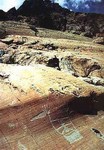
What strikes first of all the visitors of the
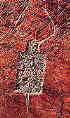
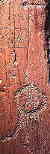
Valley of the Miracles "vallée des Merveilles", it is the big number
of horned figures that it will meet and what establishes in fact the great
majority of carvings. A representation of the wild bull, especially with
exaggeration of horns is characteristic of a cult of the fertility which is
attested throughout the Age of the Bronze on all the circumference of the Mediterranean
sea. The bull was worshipped as epiphany of the male fertility. Such a cult, we
saw it, is characteristic of a primitive agricultural civilization and it was
doubtless passed on during ages. We can thus deduct from, that the people
responsible for the plan of these figures were above all agricultural people (or
breeders) and not hunters. If these people were agricultural, we also saw that
such a cult of the fertility had to come along with rites relating to the cult
of the space and the house. And indeed, a lot of of "pattern like
figures" or associations of it doubtless evoke houses and parts or
rudiments of cadastres.
 |
 |
 |
 |
 |
The evolving societies, if they keep certain
cultural and religious inheritances of their ancestors which have still certain
significance, certain meaning - doubtless different from the original meaning -
they add to their spiritual building conceptions which get momentum from made
technical progress. So the carvings of the Valley of the Merveilles inform us
more about the culture of these people who practiced certainly the large-scale
breeding and who had a metal industry rapidly expanding. Furthermore, the
importance which seems to be given to weapons would let think that the caste
warrior had to have an importance and certain power.
Caramy Valley
We find more figures there giving evidence of a
rite of the fertility without representation of bulls. Furthermore we find
several representations of the goddess mother, in agreement with the neolithic
steles of Provence. So the neolithic or post-neolithic character could be
established on these simple observations. The scene of hunting of the cave
Chuchy shows us that certain faiths of the "hunters" were passed
on through the millenniums, doubtless by losing of their importance, but adding
to the faiths inherited from the agriculture. The dating based on the made
excavations supplies us a new temporal mark.
Relationship between the painted or engraved object and the period of elaboration
We see that the use of the data described in the
previous chapter in the Valley of the
"Merveilles" and in the valley of
Caramy (including Ollioules gorges
moreover) allows us to place them chronologically in a certainly rough but
significant way, and to understand the general sense of the works. The more
precise dates which are supplied to us by other means allow to refine our means
of interpretation.
* The presence of horned figures seems characteristic of the first civilizations of the age of the bronze, and especially the mid bronze (they are absent in the Var).* At the Age of the Bronze, the worship of the goddess mother and of the cosmic tree seems gone out of use whereas the worship of the living space and the house is preserved (worship or conservation of the sacred character without real worship in the proper sense of the word).
* In the énéolithique and until the first times of the Age of the Bronze, we notice a firm cult of the fertility and the sexual relations, with a durability of the worship of the goddess mother; but the cosmic tree even there seems to have lost of its importance. The living space and the house are still represented on the sacred pictures. The big game hunting seems to have disappeared as essential sacred act and seems to have to play rather a role of defense of the cultures.
In the following chapter we will try to apply such a concept to date the shelter of Gueillet in a culture or a given time.
Tentative for a dating of the paintings of the Gueillet shelter
The first interesting aspect of the Gueillet shelter is the abundance of pattern-like figures. It seems reasonable to consider them as representations of the environment, even the symbolic embryos of cadastres. So we could interpret them as symbols of sacralisation of the living space and the home what would attribute them to a neolithic or post-neolithic culture. Human-like or tree-like associations, representations of the cosmic tree and the man, could confirm this hypothesis; the relative positions could also have some importance by meaning that the man, by having the head above the tree, touches the sky and own a piece of divine essence (we know that already in this time, " the soul " was placed in the head - cult of skulls). Finally, we could also interpret them as a representation of the ascent of the soul after the death what would give evidence from a faith to the post-existence, either the symbolization of the trance of the shaman.
Figures representing animals represent of the big game, ibex or deer, what would tend to say that the customs of the peoples hunters had not completely disappeared (note the loss of the initiatory character, the shelter is opened and easily reachable), but the dimension of horns shows that in this archaic symbol overlaps a rite of the fertility as the horns of bull are a symbol or an épiphanie. We could oppose this interpretation with the absence of representation of the goddess mother or of more striking symbol of a cult of the fertility. But as we have already noticed it, contrary to the caves of Ollioules or Caramy, the paintings here are hidden in no way. By their nature these rites demand certain secret, even religious communion with the earth: deep caves, darkness, difficulties of access. Here the exposure of the shelter thus forbade obviously representations of such rites but allowed to represent what was less taboo and what has a link to the cosmogony. We can remind that the Mongolian yurts, the symbols of the cosmogony, are, obviously, not hidden. And all the symbols which we were able to interpret so far concerned exactly the cosmogony, and we could suppose that it is true also for the other signs, in particular for the geometrical figures and the motives which are in big number as the signs "=" for example.
Finally, we can again deduct from the paintings of the shelter of Gueillet that the creative people already had to be strongly sedentar and provided with an evolved social order.
In view of the previous chapters, we could thus suppose that these paintings characterize an already enough advanced neolithic culture but not having however abandoned the hunting, already strongly sedentar and possessing villages. Finally if we consider that this civilization did not still know, or used little metals (see on this subject the page of this site on the dolmen), we would be pushed to date it from the beginning of the Age of the Bronze or at about 2000 years before Christ.
Anati Emmanuel; "L'art rupestre, Néguev et Sinaï"; Collection les traces de l'homme, éditions l'équerre.
Briard J.; "L'age du bronze"; Paris; P.U.F. "que sais-je" 1976.
Duby; "Histoire de France"; Larousse.
Eliade M.; "Histoire des croyances et des idées religieuses"; Payot.
Glory A., Martinez F., Georgeot P., Neukirch H.; "Les peintures de l'age du bronze en France méridionale"; Préhistoire X, 1948.
Lumley H., Fonvielle M.J., Abelanet J.; "livret guide de l'expédition C1 - Vallée des merveilles"; U.I.S.P.P.
Perpere J.C.; "Les pierres qui parlent"; Éditions France Empire.
Roisin M.; "Un mystère élucidé; la vallée des merveilles - le culte interdit de Mithra"; Science et vie n° 603; 1967.
Roudil O. et Berard G.; "Les sépultures mégalithiques du Var"; Editions du CNRS.
Les dossiers de l'archéologie:
- n° 23: La vallée des Merveilles
- n° 37: Au temps des gaulois dans le midi de la France
- n° 44: Les premiers paysans
- n° 48: Dieux et religions antiques dans les Alpes
| For more information on the Age of the Bronze in the region of Provence-Alpes-Côte-d'Azur, click the icon: |
|

Back to the
general presentation: 
