Le Val decorated shelter
Chuchy cave
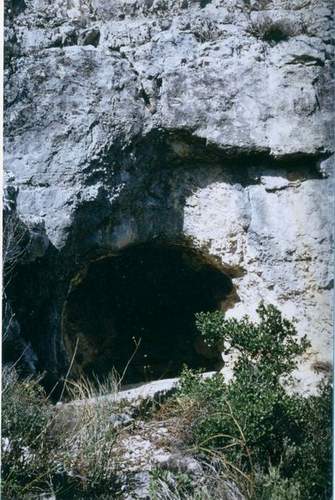
The cave Chuchy is a part of the complex of caves of the valley of Caramy river, but its symbolic and artistic importance deserves a separate chapter.
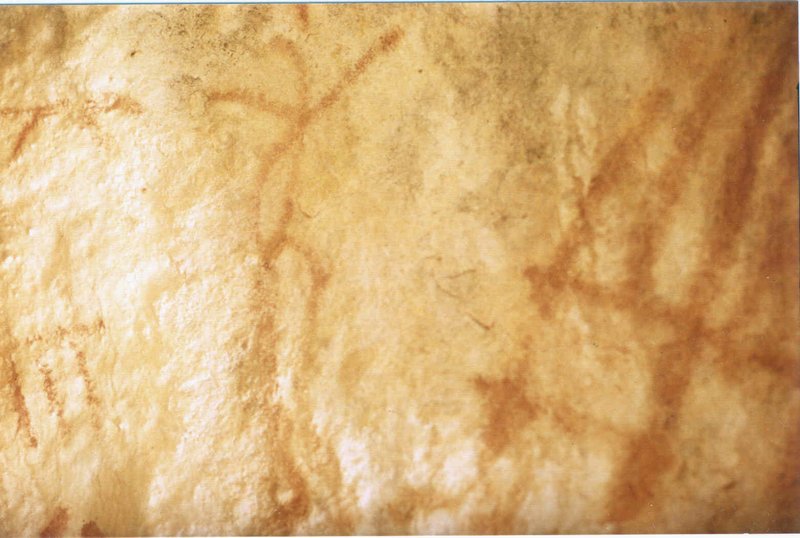
It opens ninety meters over the bottom of the valley, at feet of the highest bar which we reach by a very stiff hillside. The hall arched, one metre and seventy-five centimeters high, two meters and forty centimeters wide, oriented to the Southeast, opens on a small room two metres and fifty centimeters deep and of a height of the order of two meters and twenty centimeters. The bottom is heightened one metre and seventy centimeters with regard to the ground and continues in the North by a narrow crack from twenty to forty centimeters wide, high of sixty, impenetrable after a length of a meter fifty centimeters. Both walls of this tunnel are covered with panels face to face containing figures drawn in reddish brown ochre with fingers. The place is considerable because the paintings are hidden and because the position to be taken to realize them or to see them is very painful.
Every panel constitutes a complete, symbolic scene, which we can interpret for the one as the fox hunting, and for the other one as the representation of the goddess mother.
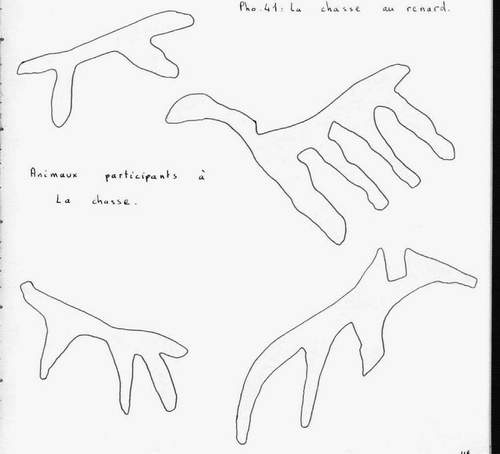
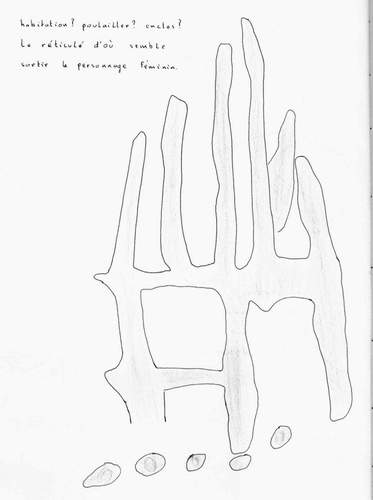
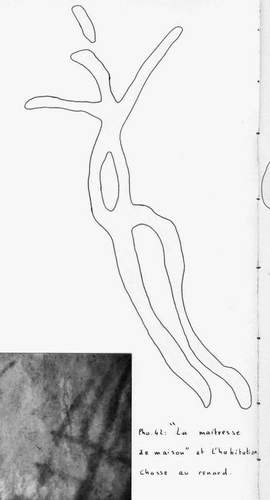
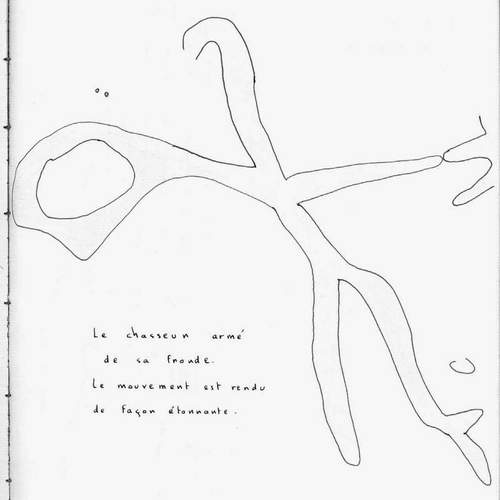
The right panel, thirty centimeters high and eighty centimeters long, evokes a scene of hunting. A woman going out of his house ( a pattern-like figure) raises arms in the sky to direct a runaway fox towards her companion armed with a sling and followed by two dogs. The hunter is in position of attack and already has shoot down lethally a first fox who is lying on the ground, the head aside and the paws displayed. From the house to the woman, the artist by a series of points doubtless wanted to represent the tracks of a sentry, either, precursor of our comic strips, her movement.
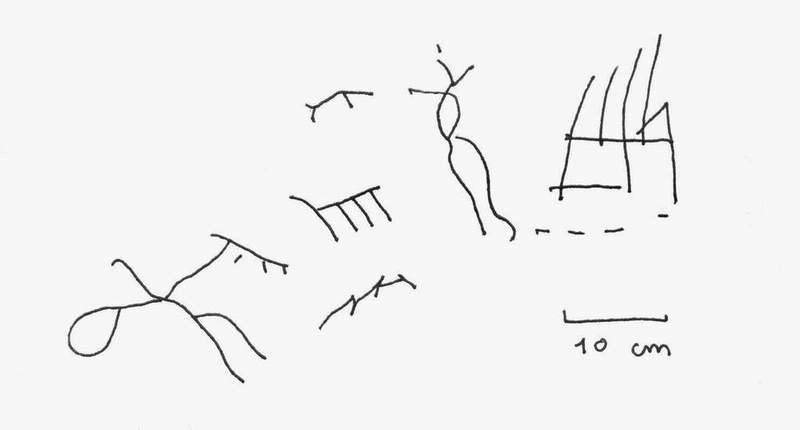
Although the fox hunting is less representative in the énéolithic age than the deer hunting, this scene is perfectly in agreement with the archaeological documents delivered by the rupestral representations and the prehistoric deposits belonging to this time. Finally, you should not forget the power which was recognized by the fox to to push aside the bad fates as shown to us by many amulets done with canines, metacarpals, of this noble animal. Pline the former, in its natural history said: " the liver of fox, or the lung in some black wine ... returns free breath " (XXVIII, 55) and: " for the gout, we use an alive cooked fox until there are not more than bones " (XXVIII, 62).
Such a scene evokes the drawings which we find from the paleolithic and which represent rites appropriate to assure a happy hunting or a ceremony of initiation; the hunter who wants to cleanse itself before the departure for the hunting which has a sacred value.
The artist knew how to well represent the movement of the scene by using different simple methods. So, the pulled down fox is drawn near the woman but is drawn by a size lower than would be needed (perspective effect?), and the contrast between the dead fox and this one is returned well by the spread paws, the tail behind and the head aside.
Below we shall find a overall transcript of the drawings:
 |
 |
 |
 |
Click on a part pf the picture (the woman and a part of the pattern-like figure) to obtain a full size picture of it:
The left panel includes a central figure whom we can interpret as a simplified idol whose only the head is separated from the body, which is reduced and rounded off in the bottom, two points representing eyes and a median line encircles it. A vertical line which insinuates itself into the convex base seem to belong to the series of five tilted or vertical sticks, capped by a point, which rise to the left of the idol by marrying her shape. To the right, four oblique crosses are above a long a little waved line the slightly curved extremity of which cuts a tronconic figure in round end. A solar-sign, formed by a circle with beams and points surmount the group. Finally, on the right, a sign reminding a hand is the last one whom we distinguish.
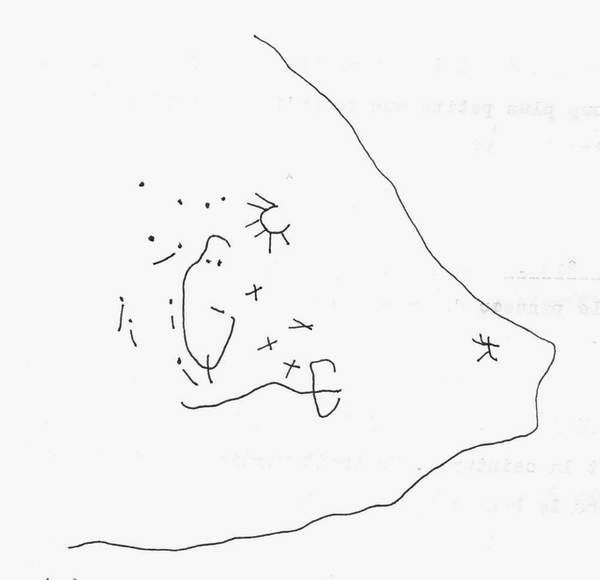
The abbot Glory interprets this scene as the representation of the big goddess mother, emblem of the universal fertility, with six men and four women around , the group being protected by the action of the sun celestial body; all this composition resting on a big ceremonial ax, the religious value of which cannot be denied.
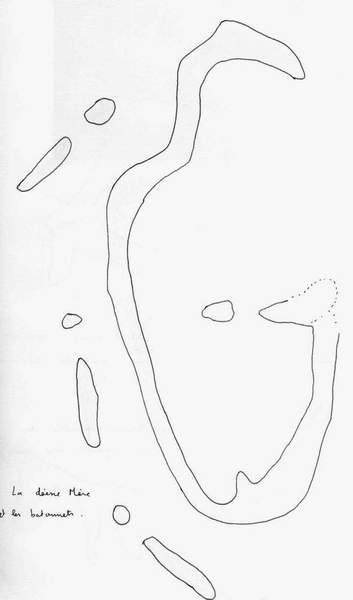
This scene, unlike the previous one, is extremely schematized and its sacred character seems stronger.
These two scenes, the one realist, the other symbolist, associated in the same cave show two of the main concerns of the neolithic of Tourves: that of the hunting to maintain the life of the tribe (even to protect a low yard??), and that of the religious ceremonies to assure by the magic, the benevolence of the divinity on the occasion of certain procreative acts.
Back to "Caramy river valley":

