Le Val decorated shelter
Caramy valley paintings
| I.
Lazaret shelter.
II. Chuchy cave V. Alain cave VI. Nicole hole
|
VII.
Hole of the two firends
X. Bernard shelter
|
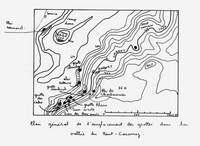
Four kilometers by the road, from the South of the village of Tourves ( the Var ), the farm of the property RIMBERT raises, built on the left bank of the Caramy (see the map of Brignoles in the part I). This torrent with flowing waters all year long, was already channeled in the time of the Roman, and fertilizes a narrow and wild valley, embanked in the middle of abrupt bathonian block lime stones covered with wood. It is on these cliffs, two hundred and fifty meters from the Roman bridge and on one thousand five hundred meters that we find nine caves decorated with paintings. We meet successively, on the left bank, the shelter of the Lazaret, the cave Chuchy, the shelter Hillaire, the cave Neukirch, the cave Alain, the hole Nicole, the hole of both friends, the cave of Cabro and on the right bank finally, the shelter of the Charbonnier (coalman).
Click the map below to see a map big size:
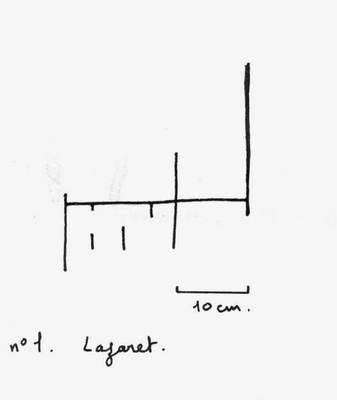
It is fifteen meters from the ground level, on a calcareous cape with very abrupt face a small shelter under cliff which contains in the heart of the central niche the vestiges of a geometrical drawing painted in dark red, formed by bars which cut themselves in right angle and which call back a pattern-like figure.
II. Chuchy cave.
One of the most interesting cave, see its specific page: Chuchy.
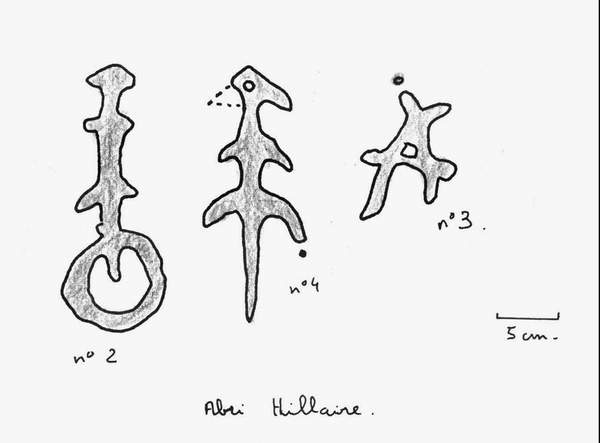
It is two hundred meters upstream from the previous cave and eighty meters over the valley. it is hardly sixty centimeters deep and one meter wide. To the left we distinguish a human-like sign ( N°2) and beside him some painted lines; opposite, to the right, with the same very dark red ochre, almost black, an enigmatic sign which seems to be formed by the juxtaposition of a pointed stick (man) and of a obliquely drawn cross (woman), simplification of the fertilizing act ( N°3). This meaning is not improbable because we find close by a long phallic-like figure provided with a head decorated with two side appendixes, with two arms and with two hanging legs ( N°4). I think nevertheless that we could interpret this figure differently by considering it (contrary to the abbot GLORY) as the representation in projection of a horned animal, such as we see them in the Valley of the Miracles and in the Valley Camonica.
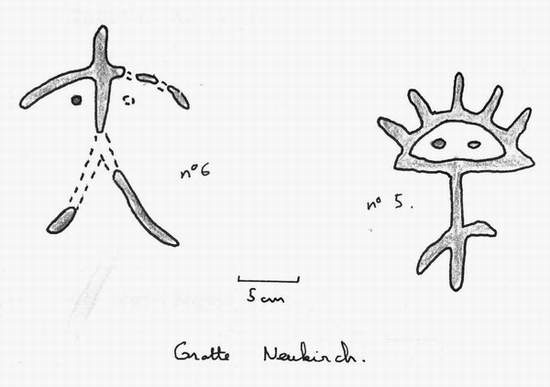
It is approximately hundred and fifty meters from the previous one and forty meters high from the bottom of the valley. We find, drawn in brown, almost black red ochre, a struck axis capped by a half-disc surmounted by five beams and made human-like lloking by two eyes ( N°5) there. We also find there another god-like stylization divided downward into two curvilinear lines; the point situated under the right arm could represent a breast ( N°6). Such an humanization of the sun or the sun god is already characteristic of an evolved religious thought and gives a sacred character to these caves.
By going back up three hundred meters upstream the side of the hill, we find, fifty meters high from the bottom of the valley, a rocky island which contains the following three caves: the cave Alain, the hole Nicole and the cave of " two friends ".
The cave Alain presents over a low entrance, one oval cartridge of twelve by twenty one centimeters, doubled in the top of a parallel line painted in dark red ochre and, one meter and fifty centimeters from the ground. A human being, arms and legs widened, is lying inside in the middle of eleven points, whereas twelve points were arranged outside. Sixty centimeters to the left, two other horseshoe signs, surmount five other red points the total of which forms twenty eight with the precedents (n°7 and 8). More searchesmade by MESSRS NEUKIRCH and Sanz Martinez supplied a big quantity of human bones, broken, associated to a rather poor funeral furniture.
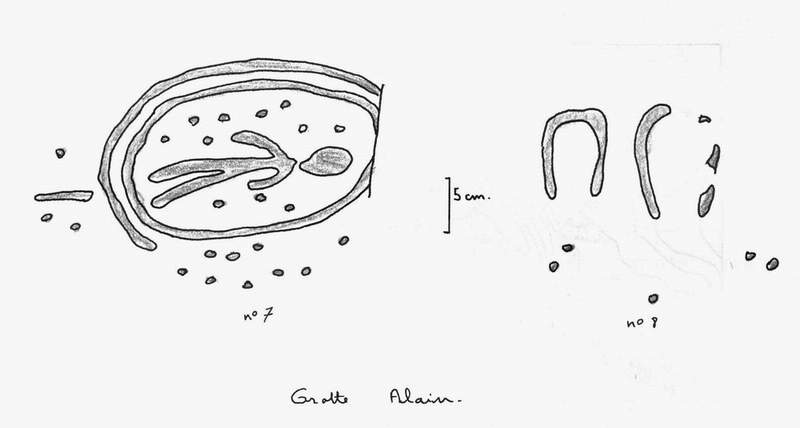
The group gives the feeling of being a tribal funeral deposit where bones were kept in the cave as recollections, as a second grave. The individual is only represented here by a part of his skeleton which had undergone removal of flesh and doubtless a ritual breaking of bones, as indicates it in so characteristic a way the painting which dominates the entrance of this ossuary. The excavations performed here, allowed to date this site between the end of the Age of the Copper and the beginning of the Age of the Bronze.
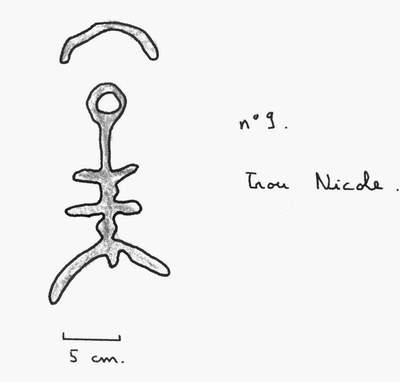
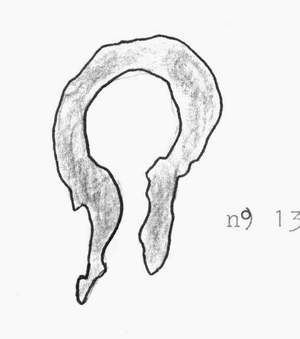
Just next to the cave Alain, we find only a single sign, human-like, given a male sex and surmounted by a curved line. We shall notice its resemblance with a horned figure from the Valley of the Miracles, the horned sign would be then what we interpret as being legs in this drawing ( n°9 ).
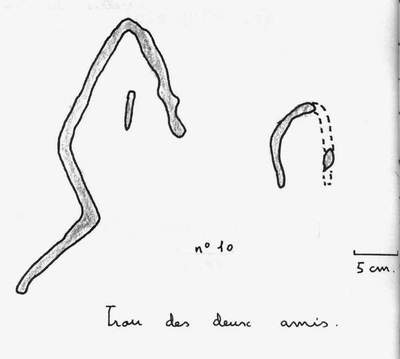
We found only in this location, two signs drawn red bauxite, the shape of horseshoe; the two of them are now very deteriorated.
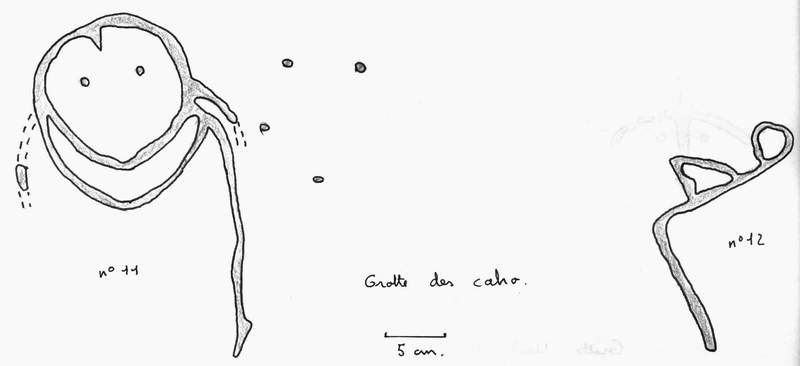
This cave contains two red bauxite signs, out of them one seems to be the beginning (n°11) of a human-like figure, similar to the goddess mother found in the Chuchy cave. The other one too could be interpreted as being a human-like figure shaped as a bow (n°12).
This is the only cave on the right side of the Caramy river, it is just in front of the Neukirch cave.
Finally in the valley of the happiness below the fortified camp, we find the shelter Bernard who contains a painting.
The overall impression which arise from this set of paintings contributes to the thesis of the representation of religious rites; drawings were always drawn in privileged places, they are generally hidden and the caves which contain them were not inhabited. They belonged to an agricultural population which had become established in the plain of Tourves, fertile and well irrigated, which extends in the outlet of the valley. In this colonization of the plain, looked for for its cultures, these énéolithiques tribes had joined the construction of a fortified camp of the type " blocked spur " covering the mountain Saint-Probace, the mountain on the hillsides of which caves with paintings are. We so find the realization of three essential functions, the plain for the function of physical survival, the fortified camp for the defence and the war, and the caves for the function of spiritual survival.
Finally this social device, caves with ritual paintings, fortified camp, cultures in the plain, was not an absurd island in the world at that eneolithic time, but it was directly connected with the second location with paintings of Ollioules, situated thirty kilometres in a straight line to the South, by a chain of stations, fortified camps and caves funeral.
Back to "an attempt to interpret":

