Le Val decorated shelter
Ollioules canyon
Between Ollioules and saint-Anne d' Evenos opens a fertile region in rupestral paintings containing the valley of the destel, the massifs of Croupatier and massif of saint - Anne's. Most of the discoveries were made by misters Sanz-Martinez, F. Dumas and the abbot Glory who divided the region into three stations:
1. Destel Valley
2. Croupatier massif
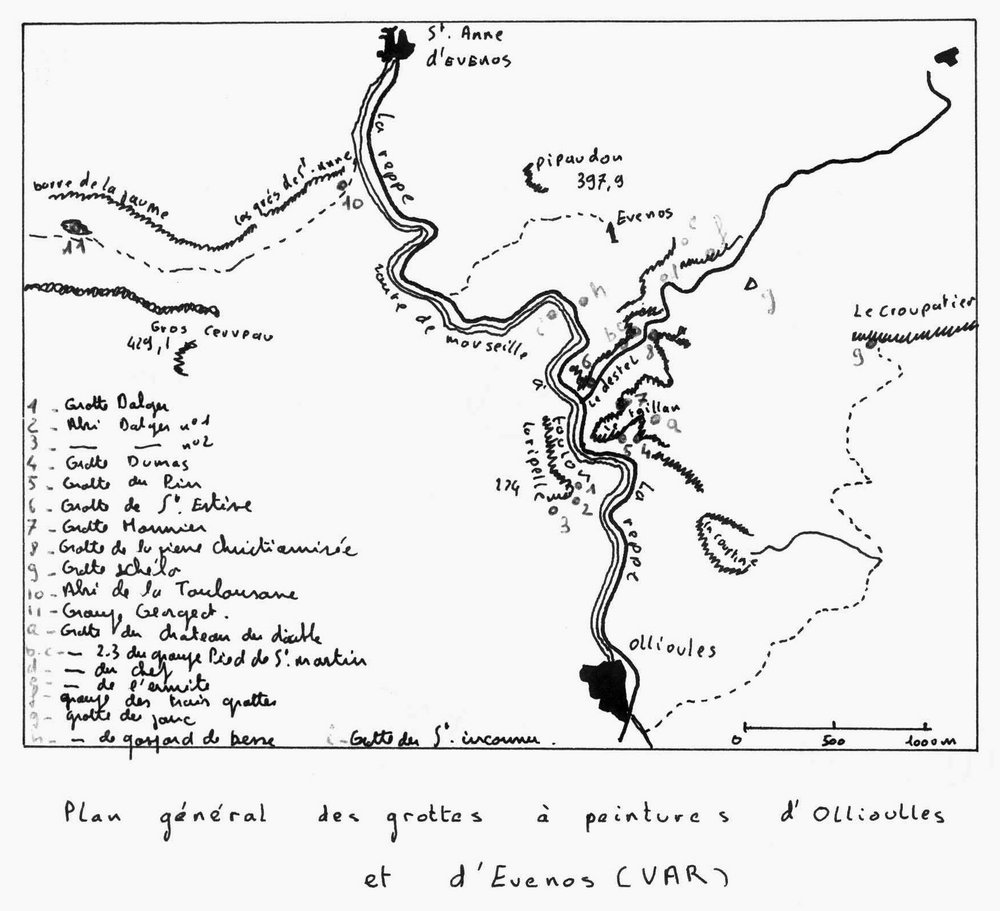
Please click on the map here upon to enlarge it.
1. Destel valley and its surroundings
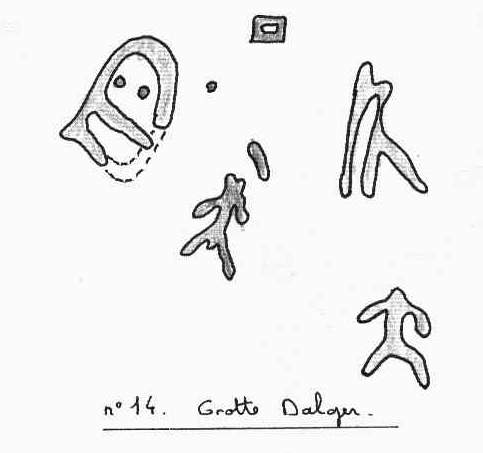
a) Alger cave
We find two types of paintings there:
A very visible group in black, brown or reddish ochre, which includes a four bars ladder in brown ochre, a black circle with a point in the centre, a male person, in brown, ochre arm shaped like a cove, provided with a stick with a two part top, a human like black figure, with no head and with a circular vulva.
The second group in very pale ochre containing three human like figures and a goddess mother in the form of stele ( n°14 ).
b) Dumas cave
This one contains only one figure, but an astounding one. It is an idol painted
in yellow ochre, with feet and an human like visage (n°15). At its side, there
a stick with a point.

Please click on the drawing here upon to enlarge it.
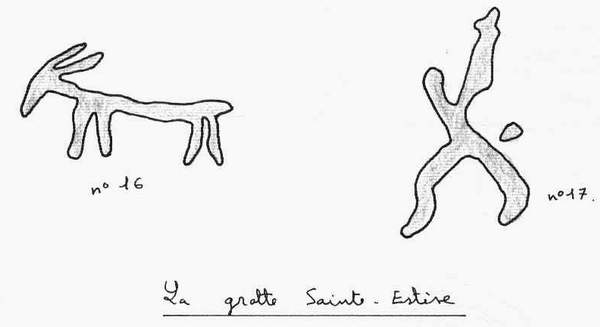
c) Saint-Estève cave
Two figures are displayed in this cave only. One seems to represent a goat
(n°16), and the other one a human like figure (n°17), hands up, which confer a
real expression of movement.
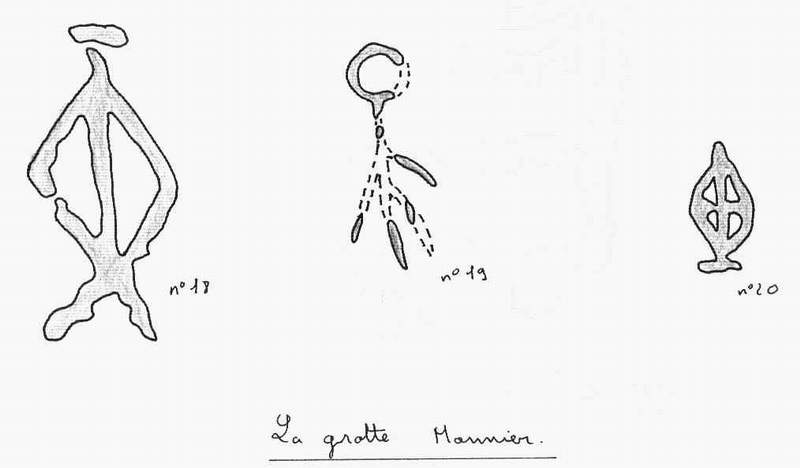
d) Monnier cave
In addition to two human like figures -
n°18&19 - and a geometric figure - n°20 - lot of remains have been
uncovered: Stone tools, adornments, bronze objects and some ceramics; human and
animal bones have also been found. Results from these searches lead to conclude
that this location could be dated contemporaneous to the one found in the Caramy
valley: eneolithic and beginning of the bronze age.
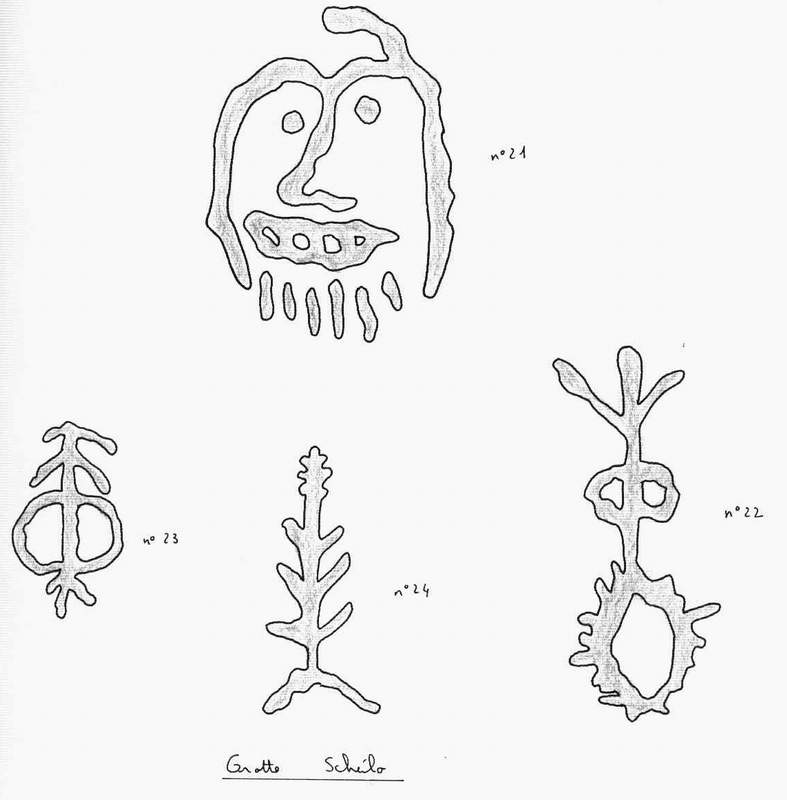
The cave Schélo, in the Croupatier massif, is the only one in which we discovered paintings. The biggest entrance, directed to the Southeast, five meters high, give access to a gallery seven meters wide which curves on itself to go out by a second opening, high and four meters wide after a route of forty eight meters.
Approximately eight meters from the entrance, in the place where the gallery bends, the artist took advantage of curves of the cliff to draw a threatening and characteristic head, in brown-red ochre. Painted Edges of the niche compose the outline of the face. Eyebrows, eyes and mouth are represented seen by face whereas the nose is seen from profile. Spread lips show a row of teeth; a short beard, formed by six vertical lines, hangs from the lower lip, whereas the skull is surmounted by a curvilinear appendix, an hairstyle ornament ( n°21 ). Eighty-five centimeters from the head, at the level of the nose and to the right, five vertical lines of the same tint represent a raised left hand, what strangely makes it look like the magician of the valley of the miracles. Do we have to see in this threatening head the sensible divinity taking away ghost which we find in the entrance of taoïst temples?
On the right wall appears, a little farther, a feminine person for which all the characters of the generation were exaggerated ( n°22 ), accompanied with a small person with a well represented male sex and which seems pointed towards the woman. Finally, we find two other persons painted in red ochre (N °23&24).
Drawings relating to the cult of the fertility are thus particularly numerous in this cave, which had to be of use as refuge to rites that we could maybe find in certain sects of the Antiquity.
a) Toulousanne shelter
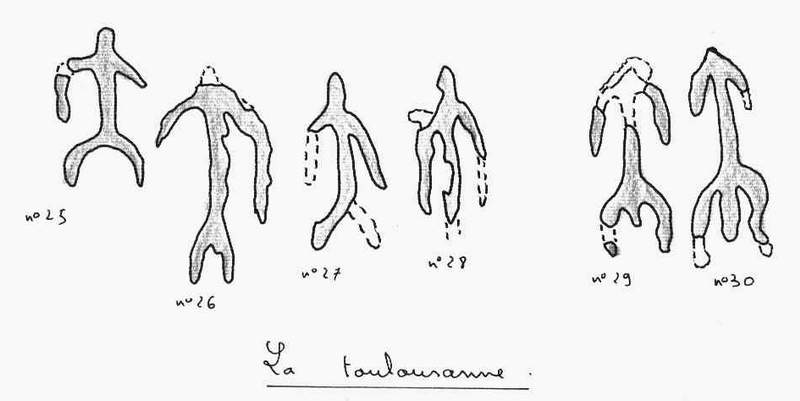
Six human like figures are displayed in this cave, four with no apparent sex,
and two males (n°25 to 30).
b) Georgeot hill of the Val d'Arenc
It is a small hill, fifteen meters high and with a diameter of roughly one
hundred meters. It contains some shelters in which we can distinguish some
rupestral engravings with a style wich is consistent with the gorges d'Ollioules
paintings one.
As we have already said it in the conclusion of the description of the valley of Caramy, these two sites are very close and are of the same time. We find here also in caves and hidden places symbols of a rite of the fertility of the agricultural populations. We shall note finally the figure 21 which already announces the figure called " the magician " in the Valley of the Miracles. Finally, the figures of the shelter of Toulousanne are very close by their aspect of those whom we find in the cliff of Gueillet.
Back
to "an attempt of interpretation": 
